
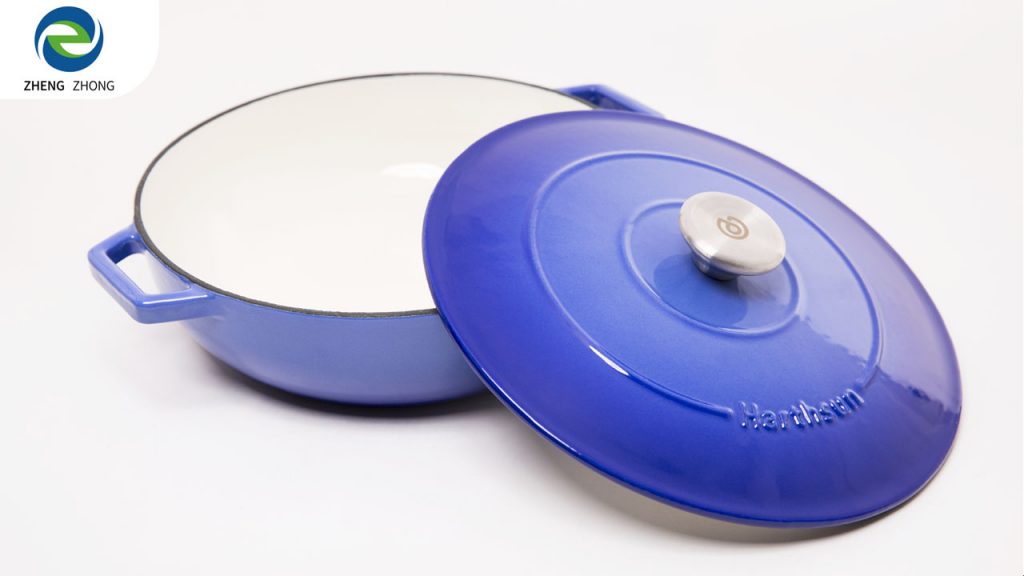
Excellence in Enamel Cast Iron Shallow Casseroles for Global Culinary Enthusiasts
An enamel cast iron shallow casserole (frequently styled as a braiser) is a premier culinary vessel that bridges the gap between a high-heat skillet and a deep Dutch oven. Featuring an expansive, flat searing base and shorter sidewalls combined with a dense iron-carbon thermal core and a non-reactive porcelain-glass glaze, it delivers unmatched performance for global culinary enthusiasts who demand precision searing, slow braising, and stunning direct-to-table presentation.
1. The Geometry of Excellence: Why Wide Bases Matter
For home chefs and professional cooks alike, the physical design of a cooking vessel dictates its culinary capability:
- The Uncrowded Searing Advantage: Unlike deep Dutch ovens that narrow toward the bottom and crowd ingredients, the shallow casserole provides a wide, flat cooking floor. This allows meats, poultry, and aromatic vegetables to lay out in a single layer, ensuring proper browning and deep caramelization rather than steaming in their own juices.
- The Thermal Battery Effect: Forged from high-density iron-carbon alloy, the shallow casserole absorbs, retains, and steadily radiates thermal energy from all directions, eliminating hot spots and maintaining stable cooking temperatures across the entire surface.
- Optimal Evaporation and Reduction: The shorter sidewalls make it effortless to stir ingredients, monitor liquid reductions, and flip foods, while still providing adequate depth for rich braising broths and heavy self-basting lids.
2. Mastery Across Multiple Culinary Techniques
The true mark of excellence is versatility. The shallow casserole excels across a diverse spectrum of cooking methods cherished by global food lovers:
- High-Heat Searing: Perfect for browning short ribs, chicken thighs, or chops before introducing liquids.
- Low-and-Slow Braising: Exceptional for dishes like coq au vin, ratatouille, and osso buco, where the tight-fitting lid and self-basting condensation bumps lock in moisture and tenderness.
- Oven Roasting & Baking: Excellent for one-pan roasted vegetable medleys, skillet gratins, and rustic fruit crumbles.
- Direct-to-Table Presentation: Finished in vibrant, chip-resistant porcelain enamel color gradients, the pan transitions gracefully from the oven or stovetop straight to the center of the dining table.
Shallow Casserole vs. Alternative Cookware
| Cookware Evaluation Metric | Enamel Cast Iron Shallow Casserole | Deep Dutch Oven | Standard Stainless Steel Skillet |
| Searing Surface Area | Maximum (Wide, flat base) | Limited (Narrower base crowds food) | Maximum (Wide flat base) |
| Thermal Heat Retention | Exceptional (Massive thermal mass) | Exceptional (Massive thermal mass) | Low to Moderate (Relies on multi-clad core) |
| Acidic Food Safety | Complete (Inert porcelain glaze) | Complete (Inert porcelain glaze) | Complete (Non-reactive metal) |
| Table Presentation Appeal | High (Vibrant enamel finishes) | High (Classic heritage look) | Low (Utilitarian metal finish) |
Frequently Asked Questions (FAQ)
What is the primary advantage of an enamel cast iron shallow casserole?
The primary advantage is its wide searing base combined with short sidewalls, which allows you to brown meats and vegetables in a single layer before transitioning smoothly into low-and-slow braising or oven baking.
Do I need to season an enameled shallow casserole?
No. Enameled shallow casseroles feature a smooth, non-porous porcelain-glass glaze that completely seals the underlying iron core. Zero oil seasoning is required or recommended.
Can a shallow casserole be used on induction cooktops?
Yes, absolutely. Because the core is manufactured from ferrous cast iron, the pan is naturally magnetic and operates with high energy efficiency on induction, gas, electric, and ceramic glass cooktops.
How do I clean baked-on residue from my shallow casserole?
Allow the pan to cool completely, then fill it with warm water and a tablespoon of baking soda to loosen any carbonized food. Wash gently using a soft sponge and mild dish soap, avoiding abrasive scouring pads to protect the glossy glaze.