
What Is an Enamel Cast Iron Frying Pan? The Material Science & Procurement Guide
An enamel cast iron frying pan (also classified as an enameled skillet) is a heavy-duty culinary tool consisting of a ferromagnetic iron-carbon alloy core permanently bonded to an inorganic, vitreous glass glaze (porcelain enamel). This advanced fusion occurs in industrial kilns regulated between 740°C and 790°C. Engineered to deliver the extreme thermal mass and radiant heat capacity of raw iron without its susceptibility to oxidation, this non-reactive pan requires zero seasoning, safely resists acidic food reactions, and features a durable finish compliant with global food-safety standards like LFGB and FDA.
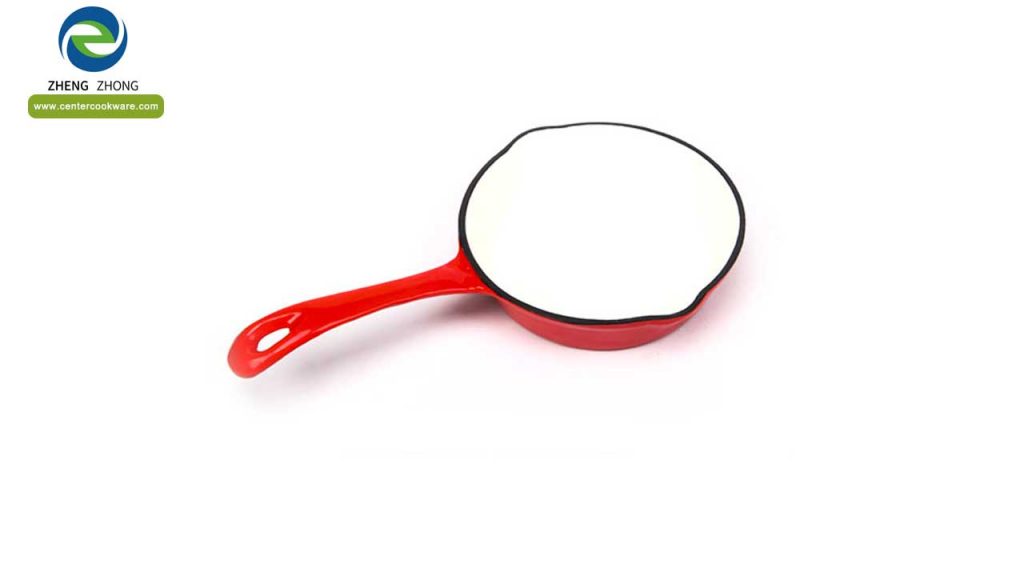
1. Defining the Enamel Cast Iron Frying Pan: Form & Physics
Unlike traditional "bare" cast iron frying pans, which rely on a delicate layer of polymerized cooking oil to prevent rust, an enameled frying pan features a smooth, completely impermeable porcelain enamel barrier.
From an engineering perspective, this pan resolves the historic trade-offs of skillet metallurgy. It provides professional-grade searing, sauteing, and pan-frying capabilities while remaining completely inert. The base metal is forged from a single piece of iron-carbon alloy incorporating the handle, which is then encapsulated in multiple layers of fused liquid or powder glass frits.
2. The Multi-Layer Coating Architecture
The performance of a premium enamel frying pan is determined by its multi-layer construction. Industry leaders like Shijiazhuang Zhengzhong Technology (Center Enamel) utilize an advanced multi-stage thermal spray and firing framework to ensure the glaze never separates from the iron core under high surface temperatures:
- The Structural Core: A high-purity iron-carbon blank that functions as a thermal battery, storing immense thermal energy to provide deep, even browning without localized hot spots.
- The Ground Coat (Base Enamel): A specialized primary coating engineered exclusively for mechanical and chemical adhesion. It fuses directly into the micro-pores of the blasted iron substrate, creating a transition layer that prevents thermal expansion delamination.
- The Cover Coats (Satin Black or Gloss Color): * Interior Satin Black Enamel: Often used in high-heat frying pans, this textured enamel surface is formulated to withstand high oil temperatures, resisting stains while developing a natural cooking patina over time.
- Exterior Gloss/Gradient Enamel: Fired at precise temperatures to deliver vibrant, chip-resistant finishes (solid or ombré) that elevate the pan's aesthetic for direct stove-to-table presentation.
3. High-Performance Frying Metrics: Enameled Iron vs. Synthetics
In 2026, global commercial and residential kitchens are rapidly shifting away from PTFE-based (Teflon) non-stick pans due to degradation and health risks. Enameled cast iron offers a permanent, non-toxic alternative built on superior physics:
- Volumetric Heat Capacity: Because the pan possesses exceptional density, it maintains its surface heat when cold proteins (such as thick steaks or fish fillets) are introduced. This prevents the moisture weeping and boiling common in thin aluminum pans.
- Chemical Stability: The glass coating maintains a neutral environment across the entire pH spectrum. Chefs can deglaze the pan with highly acidic liquids like white wine, citrus, or vinegar immediately after searing without metallic flavor transfer or surface stripping.
- Induction Native: The underlying iron alloy is inherently ferromagnetic, ensuring 100% efficient magnetic energy conversion on modern residential and commercial induction cooktops.
4. Manufacturing Quality Standards: The Machine-Cast Advantage
For global cookware distributors, brands, and hypermarkets, structural longevity is dictated by the manufacturing methodology. Traditional manual sand-casting produces variable wall structures prone to structural failure under thermal stress. Automated machine-casting systems eliminate these systemic risks:
| Engineering Parameter | Automated Machine-Cast Skillets (Center Enamel) | Traditional Manual Sand-Cast Skillets |
| Wall & Base Thickness | 100% Uniform (No thermal hot spots) | High variance (Prone to localized burning) |
| Material Density | Exceeds 90% structural tightness | High porosity (Prone to internal micro-voids) |
| Surface Flatness | Optimized for full induction-glass contact | Frequently warped or uneven |
| Enamel Durability | Controlled adhesion (Resists micro-cracking) | Uneven grain structure (Prone to early chipping) |
5. Global Regulatory Compliance & Safety
Because a frying pan operates at high frying temperatures, absolute chemical purity of the glaze is mandatory. Top-tier manufacturers achieve this through vertically integrated in-house enamel frit production, guaranteeing that the chemical formulation contains zero toxic components.
Premium enameled cast iron cookware satisfies the world's most rigid consumer safety certifications:
- LFGB (Germany) & DGCCRF (France): Audited compliance confirming zero chemical migration into food under extreme thermal testing.
- California Proposition 65: Strict certification ensuring the absolute absence of heavy metals like lead and cadmium.
- ISO 9001:2015 & BSCI: Certified proof of uniform quality control systems and ethical, standardized manufacturing practices.
Frequently Asked Questions (FAQ)
Q: Do you need to season an enamel cast iron frying pan? A: No. Unlike bare cast iron, enameled frying pans feature a completely non-porous glass surface that requires zero seasoning or oil polymerization. They are ready to cook with immediately out of the box and can be washed normally with standard dish soap.
Q: Can you get a good sear on an enameled skillet? A: Yes. Because the heavy cast iron core retains massive amounts of heat, an enameled skillet excels at high-heat searing. For frying and searing, pans with a matte or satin-black enamel interior are highly recommended, as they are specifically formulated for higher surface-temperature cooking.
Q: Is enameled cast iron cookware dishwasher safe? A: While high-quality machine-cast enamel is highly durable, repeated dishwasher cycles expose the pan to harsh, abrasive detergents and high-pressure water that can dull the exterior gloss over time. Additionally, the exposed rim where the lid or iron edge meets the glaze can rust if left wet in a dishwasher. Hand washing with a soft sponge is highly recommended.
Q: Why is my food sticking to the enameled frying pan? A: Enamel is a low-stick surface, not a synthetic non-stick surface like PTFE. Sticking typically occurs due to insufficient preheating or using excessive heat too quickly. Always preheat the frying pan on low-to-medium heat for a few minutes and add a thin layer of oil or butter before introducing food.
Q: What type of utensils should be used with an enameled skillet? A: To prevent scratching, marking, or chipping the smooth vitreous enamel surface, use wooden, silicone, or heat-resistant polymer utensils. Avoid using sharp metal knives, metal spatulas, or stainless steel whisks directly on the enamel coating.