
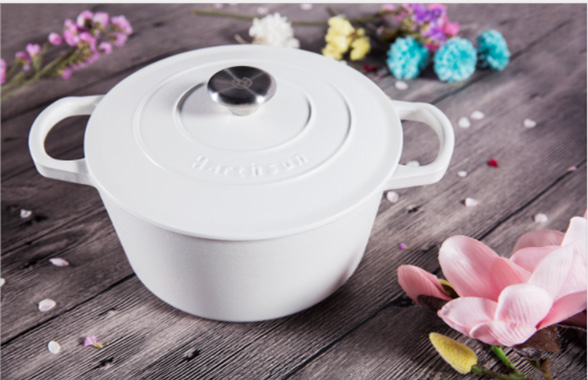
What Is Enamel and Enameled Cast Iron Cookware? The Definitive Explainer
Enamel is a glassy, protective coating made from melted porcelain frits fused onto metal at high kiln temperatures, while enameled cast iron cookware is a heavy-duty kitchen vessel made from an iron-carbon alloy core completely sealed inside this smooth, non-porous vitreous glass glaze. This combination merges the legendary thermal mass and uniform heat retention of traditional cast iron with a 100% rustproof, acid-safe surface that requires zero oil seasoning.
1. What Exactly Is Enamel? (The Material Science)
To understand enameled cookware, you first need to understand the coating itself. Enamel used in high-end kitchenware is not ordinary paint or standard ceramic; it is vitreous (glass) enamel.
- The Formulation: Enamel is created by grinding specific inorganic minerals, glass powder, and color pigments into a substance known as a "frit."
- The Firing Process: This frit is sprayed or dipped onto a metal blank and fired in industrial kilns at extreme temperatures ranging between 740°C and 790°C (1,364°F to 1,454°F).
- Permanent Fusion: At these high temperatures, the glass melts and bonds permanently with the metal substrate, creating a hard, inert, glass-like shield that protects the underlying metal from corrosion, scratching, and chemical reactions.
2. What Is Enameled Cast Iron Cookware?
Enameled cast iron cookware takes the raw, heavy-duty metal foundation of traditional cast iron and upgrades it with this protective glass shield.
- The Iron Core: The body of the pot or skillet is formed from a dense iron-carbon alloy. Premium manufacturers utilize automated machine-casting to ensure uniform wall thicknesses and absolute structural integrity.
- The Dual-Layer Enamel Coating: The pot is coated with multiple layers of porcelain enamel—typically a textured matte or light-colored gloss interior designed to handle cooking friction, and vibrant, colored exterior glosses or gradients that provide visual elegance.
- The Result: You get a vessel that acts as a thermal battery, holding and radiating heat evenly, but with zero requirement for oil polymerization (seasoning) or rust maintenance.
3. Key Advantages of Enameled Cast Iron
The marriage of cast iron and porcelain enamel creates a unique set of culinary benefits:
- Permanent Rust Immunity: Because the glass glaze completely seals the iron core from ambient oxygen and moisture, the cookware cannot oxidize or form red rust.
- Complete Acidic Food Compatibility: High-acid ingredients like tomato marinara, citrus juices, and wine-based reductions will strip seasoning off raw iron and leach a metallic taste. The inert glass glaze handles any pH level safely.
- Zero Seasoning Needed: You can wash an enameled Dutch oven with regular dish soap and water immediately, requiring no post-wash oiling rituals.
Enamel vs. Raw Cast Iron Core Properties
| Feature / Attribute | Vitreous Enamel Glaze | Raw Cast Iron Core | Enameled Cast Iron (Combined) |
| Primary Material | Fused porcelain-glass frits | Iron-carbon alloy metal | Glass-sealed heavy metal core |
| Rust Protection | 100% rustproof barrier | Vulnerable to oxidation if damp | 100% rustproof and corrosion-resistant |
| Seasoning Requirement | None (Smooth, non-porous glass) | Ongoing oil polymerization | None required |
| Acid Reactivity | Completely inert across all pH levels | Highly reactive to acids | Safe for long-simmered tomato and wine sauces |
| Thermal Mass | Low (Serves as protective shield) | Exceptional (Absorbs and stores heat) | Exceptional thermal retention with easy upkeep |
Frequently Asked Questions (FAQ)
What is enamel made of on cookware?
Enamel on high-quality cookware is made of vitreous porcelain-glass frits—a mixture of powdered glass, minerals, and natural color oxides that are melted and fused onto a metal base at extreme kiln temperatures.
Is enameled cast iron cookware safe from toxic chemicals?
Yes. Premium enameled cast iron is completely free from synthetic non-stick polymers (such as PFAS, PFOA, and PTFE) as well as toxic heavy metals like lead and cadmium, complying with strict food safety standards like LFGB and Proposition 65.
Does enameled cast iron require oil seasoning like raw cast iron?
No. Because the cooking surface is sealed with a smooth, non-porous porcelain-glass glaze, zero oil seasoning is required. You can wash the pot with mild dish soap and water and begin cooking immediately.
Can you use metal utensils on enameled cast iron?
While the porcelain glaze is tough, using sharp metal knives, metal whisks, or harsh metal spatulas is discouraged. Metal edges can scratch, dull, or eventually chip the glossy interior glass glaze. Wooden, silicone, or nylon tools are recommended.